Creative design has always mattered. Nothing drives attention to social media content (whether organic or ads) more than the image or video paired with it. What has changed is that teams no longer need to wait until a campaign is live to know whether a visual will perform.
AI-driven creative intelligence now allows marketers to predict attention, comprehension, and conversion potential before content reaches an audience.
Tools powered by neuroscience and machine learning are turning creative performance into a measurable, optimizable input rather than a subjective design debate.
How AI Creative Design Intelligence Works
Tools such as Neurons, apply neuroscience-based datasets built from eye-tracking and brain-scanning studies across hundreds of thousands of participants. These datasets allow your creative team to forecast how audiences will visually process creative assets, including:
- Where their eyes will go first
- Which elements are most likely to be noticed and remembered – i.e., how likely they are to engage with it.
- How quickly a message is understood
- Whether calls to action stand out in mobile-first environments
Instead of relying solely on subjective design reviews or post-launch A/B testing, integrated teams can pre-optimize creative with data-backed confidence.
Why This Matters for Integrated Communications
In crowded social feeds and increasingly competitive paid environments, creative performance directly impacts efficiency across channels. If creative fails to engage, even the strongest targeting, messaging, or media strategy will underperform.
AI-based pre-optimization testing allows teams to:
- Ensure visual hierarchy supports the primary message.
- Improve CTA visibility and contrast for mobile-first consumption.
- Standardize high-performing layouts across paid, owned, and earned channels.
For PR amplification, executive thought leadership, event promotion, and demand generation, creative quality becomes a measurable and repeatable contributor to performance rather than a matter of taste.
Case Study: The Impact of Pre-Optimizing Creative
A B2B professional services organization partnered with an agency to apply AI-based image pre-optimization to its digital campaign creative.
Before optimization, performance metrics showed:
- $120 cost per lead
- $8 cost per click
- 24% form submission rate
- 32% lead-to-MQL conversion rate
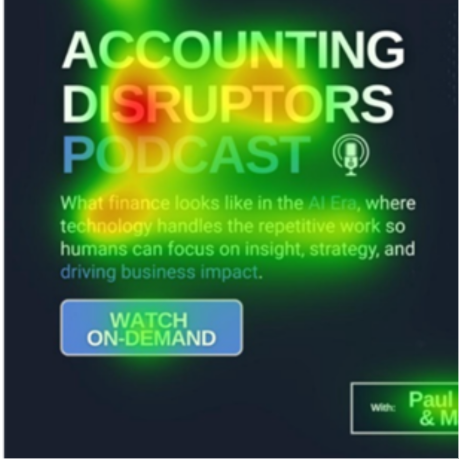
After redesigning visuals based on AI-driven recommendations, including adjusting CTA placement, improved contrast and prominence, simplified copy hierarchy, and alignment on layout with natural eye-movement patterns, the same campaign achieved:
- $87 cost per lead (27.5% decrease)
- $5.25 cost per click (34% decrease)
- 32.19% form submission rate
- 56% lead-to-MQL conversion rate
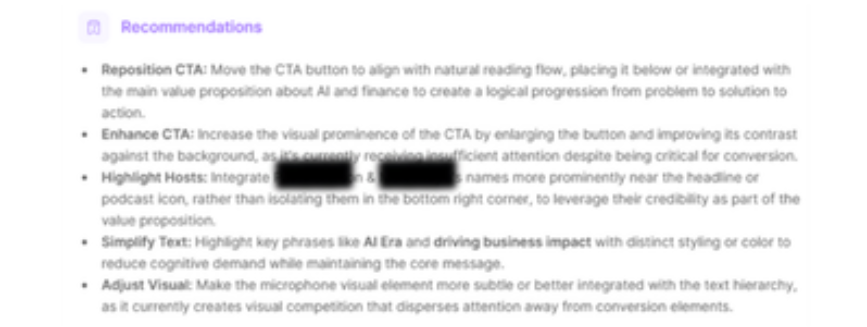
These gains demonstrate that optimized creative does more than improve aesthetics. It directly improves downstream business outcomes by ensuring critical elements are processed quickly and clearly by the viewer.
While A/B testing still plays a role, pre-optimization creates a stronger foundation before campaigns ever go live.
How Integrated Teams Can Apply AI Creative Optimization
An effective creative optimization workflow typically includes:
- Uploading initial designs into an AI pre-testing platform.
- Reviewing predicted attention scores and heatmaps.
- Applying recommended changes to hierarchy, text approach, and CTA placement.
- Iterating with designers until the visual meets both brand guidelines and performance thresholds.
- Using the resulting insights to inform future templates and campaigns.
This process can be applied across paid social ads, LinkedIn document and carousel assets, executive thought-leadership visuals, video assets, webinar promotions, and even long-form PDF reports.
Any format where visual processing speed and clarity influence engagement can benefit.
The Takeaway
Creative that fails to capture attention in the first moments is effectively invisible. AI-powered image and creative optimization give integrated communications teams a repeatable way to reduce wasted spend and ensure that key important messages are actually seen and understood.
As AI reshapes how content is evaluated and delivered, creative performance is becoming a baseline capability rather than a competitive advantage.
Want to see how AI is changing discovery and visibility beyond creative? Check out the first blog in this series which covers how AI search is reshaping integrated communications.