Gartner predicts that 50% of supply chain management (SCM) solutions will incorporate agentic AI capabilities by 2030. As the supply chain industry navigates skills shortages alongside accelerating digitization and automation, it has become a natural proving ground for AI adoption.
The challenge? Many AI case studies remain dense with technical detail, making them difficult for business leaders to interpret and act on.
While AI adoption continues to accelerate, AI storytelling has not kept pace. Early enthusiasm around new capabilities was compelling, but the business impact is often unclear. This gap presents a critical opportunity for communications leaders to translate complex AI use cases into narratives that resonate with executives, investors, and the business press.
This blog will explore opportunities for communications professionals to translate complex AI implementations and use cases into compelling business narratives.
What Narratives Are Winning in Supply Chain AI Coverage
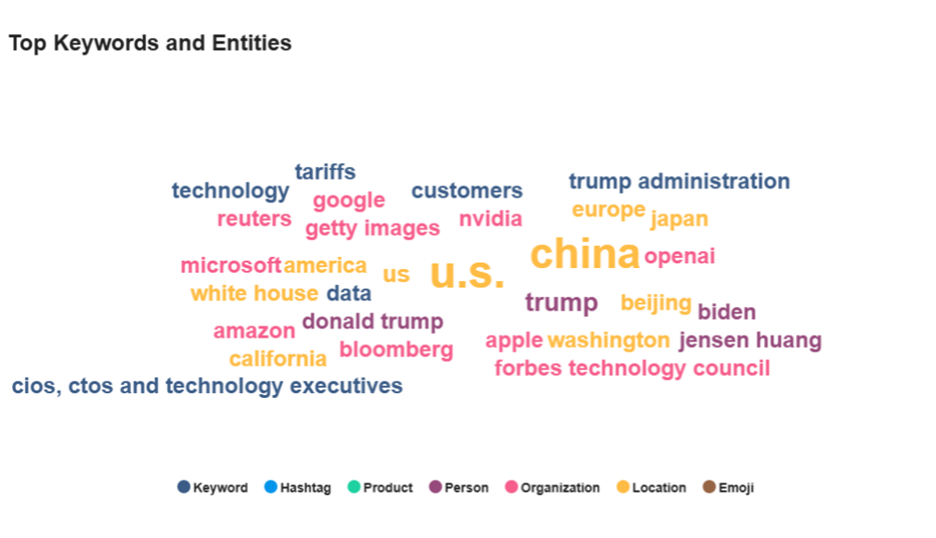
To build effective stories, it helps to look at which narratives have resonated in the media over the past year. At the intersection of AI and supply chains, US-based business press coverage has been shaped largely by geopolitical and economic forces.
AI as Industrial Infrastructure
Recent coverage makes it clear that AI is no longer treated as a standalone technology story. Instead, it’s framed as core industrial infrastructure, inseparable from semiconductor manufacturing capacity, supply chain security, and national competitiveness. Stories focus on advanced chip production, domestic manufacturing expansion, and the physical realities (e.g. power) required to scale AI.
How are Geopolitics and Trade Impacting the Media
Another dominant theme ties AI directly to global trade dynamics. Coverage highlights tariffs, export controls, rare earth dependencies, and tensions between the U.S., China, and allied manufacturing hubs. In these stories, AI and semiconductor supply chains are framed as economic and security levers, not just technology policy concerns.
Corporate Strategy and Executive-Led AI Commentary
Coverage featured CEO perspectives from large public companies at some of the leading AI organizations and CEOs from public companies that use AI innovations. These stories highlight how enterprise leaders view AI as a driver of productivity, investment strategy, workforce transformation, and long-term growth. Forbes Technology Council was an important avenue for more technical voices – such as CIOs, CTOs and other technology executives – to discuss AI within corporate strategy.
Overall, coverage framed AI as foundational infrastructure that is tightly connected to chips, energy, trade policy, manufacturing capacity, and economic power. The narrative has decisively shifted away from AI’s theoretical potential toward its role in shaping resilience, competitiveness, and national strategy.
Why Business Impact Matters More Than Features in AI Storytelling
Why do so many AI stories fail to break through with business audiences?
Because feature-driven messaging rarely resonates beyond technical readers. Companies often hope for high-profile coverage while leading with product capabilities, model architecture, or system features. Business journalists and executive audiences are far more interested in the operational and economic implications those capabilities enable.
To succeed, AI narratives must start with the problem environment first and position technology as the enabler, not the headline.
How to Translate Supply Chain AI Use Cases into Business Narratives
Demand Forecasting: Faster Decisions in an Unpredictable Market
- What companies care about: Machine learning models that generate more accurate demand forecasts, a core function of SCM.
- What business press is covering: Geopolitical instability and market volatility that require organizations to adapt plans quickly.
The story is not forecast accuracy alone. It is the uncertainty reshaping global markets and how supply chain leaders can update plans in near real time as conditions change. AI becomes relevant because volatility has become the norm.
Logistics Optimization: Building Resilience Amidst Disruption
- What companies care about: AI-powered route optimization and logistics analytics
- What business press is covering: Material shortages, weather events, and transportation disruptions.
Rather than positioning AI as a way to marginally improve delivery speed, the stronger narrative is resilience. AI enables organizations to reduce exposure to disruptions while maintaining service levels when unexpected events occur.
Workforce Augmentation: Doing More with a Smaller, Stretched Team
- What companies care about: AI tools that automate and support operational tasks.
- What business press is covering: labor shortages, employment trends, and rising costs.
From warehouses to control towers, many supply chain organizations are operating with smaller teams. AI is not about replacing workers. It is about extending the capacity of existing teams to maintain continuity, productivity, and profitability even as cost pressures increase.
How Supply Chain Communicators Can Leverage AI
If you represent a major AI platform provider, landing coverage for technical innovation is often easier. For most organizations, success requires a more strategic approach.
Feature-driven messaging may resonate with technical audiences, but it rarely lands with business press, investors, or executive readers. Impact-driven narratives that connect AI to resilience, competitiveness, and economic outcomes are far more effective.
For companies looking to move beyond capability-first messaging and place more strategic supply chain AI stories, integrated media relations and executive positioning play a critical role.
Learn more about 10Fold’s media relations services.