10Fold’s latest research reveals three marketing investment areas gaining momentum and three established disciplines facing greater pressure to demonstrate results.
B2B technology marketers are entering 2027 with bigger budgets and bigger expectations. But not every marketing investment is delivering equally strong results.
According to 10Fold’s 2027 Marketing Budget Blueprint, 80% of senior technology marketing leaders expect their budgets to increase, while 65% anticipate more ambitious performance goals.
Our survey of 400 marketing leaders reveals several surprises. AI discovery is emerging as a strong performer, customer marketing is keeping pace, and marketing infrastructure is delivering better-than-expected results. Meanwhile, several established disciplines face pressure to demonstrate their value.
The Marketing Performance Scorecard
Respondents evaluated the performance of the marketing categories they identified among their three most critical priorities.
| Marketing category | Program exceeded expectations | Program underperformed |
| AI discovery and AI-search visibility | 46% | 8% |
| Customer marketing and retention | 46% | 18% |
| Marketing technology, infrastructure and measurement | 42% | 13% |
| Events and experiential marketing | 41% | 20% |
| Social media and influencer marketing | 40% | 14% |
| Training and professional development | 40% | 13% |
| Lead generation and performance marketing | 39% | 17% |
| Product marketing | 39% | 13% |
| Partner and channel marketing | 39% | 22% |
| Marketing research, strategy and analyst relations | 38% | 10% |
| Paid advertising | 37% | 22% |
| Content and thought leadership | 35% | 14% |
| Public relations and corporate communications | 30% | 9% |
Let’s examine the three leading performers and three areas facing challenges.
Winner #1: AI Discovery Becomes a Core Marketing Investment
Among the 136 respondents identifying AI discovery as a top-three priority, 46% reported above-expectations performance, while only 8% reported underperformance. AI discovery also accounts for an average of 10% of planned marketing budgets, and 74% of respondents investing in the category expect to increase spending in 2027. This suggests AI discovery is moving beyond experimentation and becoming an established marketing investment.
As technology buyers increasingly use AI-powered tools to research and compare vendors, marketers must understand how their brands appear in AI-generated answers, which sources influence those answers and whether their messages reach relevant audiences.
What marketers can do: Integrate AI discovery with content, earned media and digital visibility programs. Establish baseline measurements for AI visibility, citations and competitive positioning, then track improvements.
Winner #2: Customer Marketing Delivers Strong Results
Customer marketing matched AI discovery’s 46% above-expectations performance. Among respondents investing in the category, 65% plan to increase spending in 2027. While B2B marketing often emphasizes acquiring new customers, retaining customers and identifying expansion opportunities can be equally important. Our research found that 30% of respondents selected customer retention among their leading marketing KPIs.
Customer communications, advocacy, references, advisory boards and retention campaigns help technology companies strengthen existing relationships and demonstrate value. However, 18% reported underperformance, suggesting success depends on effective execution.
What marketers can do: Give customer marketing a defined role in the marketing plan. Measure retention, expansion, advocacy and engagement rather than treating customer communications as a secondary function.
Winner #3: Marketing Infrastructure Becomes a Competitive Advantage
Marketing technology, infrastructure, data, measurement and reporting also performed strongly. Among 130 respondents identifying this category as a top-three priority, 42% reported results above expectations. Often considered an operational expense, marketing infrastructure can be a competitive advantage. Effective execution increasingly depends on integrated systems, reliable data, automation and meaningful measurement.
AI makes these capabilities more important. Without them, organizations may struggle to realize the benefits of their investments.
When explaining underperformance, 26% of respondents cited weak targeting or data, while 19% identified attribution difficulties.
What marketers can do: Prioritize data quality, technology integration and measurement. Infrastructure improvements can strengthen multiple marketing programs simultaneously.
Three Marketing Disciplines Facing Greater Pressure
Not every program with lower above-expectations performance is failing. Some consistently meet expectations. However, three areas warrant closer examination.
1. Paid Advertising: Spending Doesn’t Guarantee Results
Paid advertising accounts for 9.8% of planned marketing budgets, yet only 37% of respondents evaluating it as a priority reported above-expectations performance, while 22% reported underperformance.
Paid programs provide reach and targeting, but traffic and lead volume don’t necessarily translate into qualified pipeline. Competition, changing buyer behavior and targeting quality can limit results.
The opportunity: Measure qualified pipeline, acquisition costs and revenue contribution. Redesign programs that generate activity without meaningful commercial outcomes.
2. Partner and Channel Marketing: Mixed Results
Partner and channel marketing presents a contrasting picture: 39% reported above-expectations performance, while 22% reported underperformance.
These programs depend on coordination between organizations, shared objectives and consistent execution. Strong partnerships can expand market reach, but poorly aligned programs may struggle despite substantial investment.
The opportunity: Establish joint objectives, clear ownership and measurable outcomes. Evaluate partner-generated opportunities rather than partnership activity alone.
3. Content Marketing: Differentiation Matters More Than Volume
Content and thought leadership recorded 35% above-expectations performance. However, only 14% reported underperformance, while 48% said content met expectations. Content isn’t broadly failing, but comparatively fewer marketers report exceptional results.
As AI accelerates production, the challenge shifts toward creating differentiated, credible content that influences buyers. Publishing more material isn’t necessarily the answer.
The opportunity: Invest in original research, proprietary expertise and executive perspectives. Measure contributions to discovery, engagement and business outcomes.
What About Public Relations?
PR presents a different performance profile. Only 30% reported results above expectations, but just 9% reported underperformance, while 47% said PR met expectations. PR was among the categories least likely to fall short, even though relatively few respondents reported exceptional performance.
Perhaps PR has a PR problem, ironically. PR may be delivering consistent results while marketers face challenges demonstrating its broader value. Traditional coverage metrics don’t fully capture how earned media contributes to credibility, competitive positioning, AI discovery or purchasing decisions.
Authoritative third-party sources can support multiple marketing objectives simultaneously.
What marketers can do: Move beyond coverage volume. Measure message penetration, competitive visibility, audience relevance, AI discovery presence and citations to demonstrate communications’ contribution to business objectives.
Why Marketing Programs Succeed or Fail
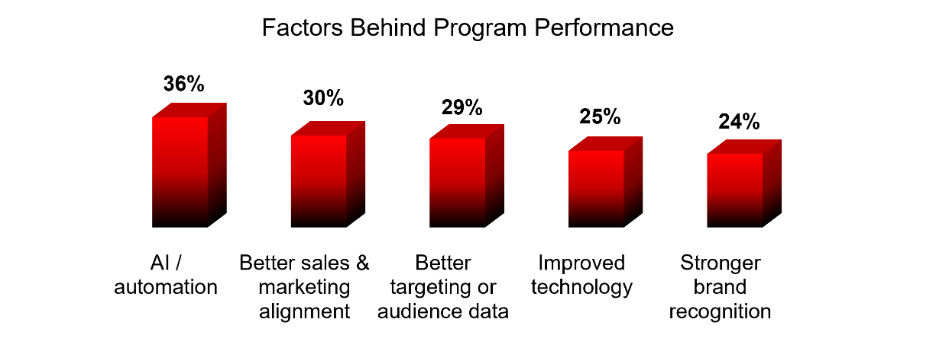
The research also examined factors behind program performance. Among 382 respondents whose priority programs met or exceeded expectations, leading explanations included AI and automation (36%), better sales and marketing alignment (30%), improved targeting or audience data (29%), improved technology (25%) and stronger brand recognition (24%).
Among 134 respondents experiencing underperformance, the leading explanations were economic conditions (36%), weak targeting or data (26%), insufficient budget (25%), increased competition (25%) and changing buyer behavior (23%).
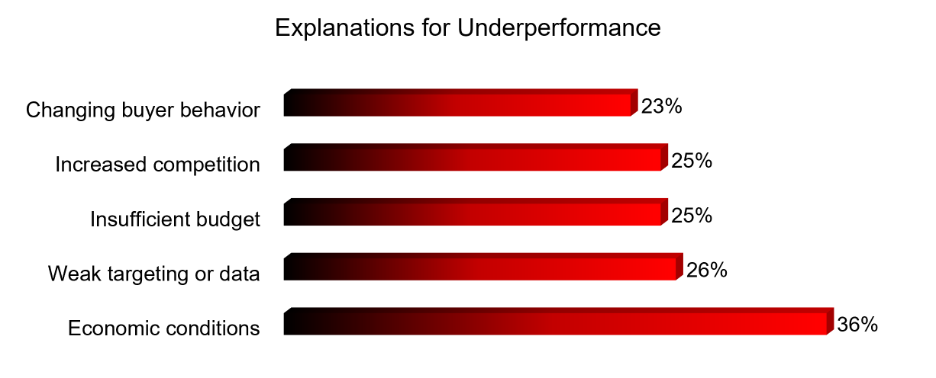
Technology and automation are contributing to stronger results, but their effectiveness depends on alignment, targeting, data quality and brand strength. Likewise, underperformance isn’t always a budget problem. External conditions and weak execution can limit results regardless of spending.
The Real Winners Connect Their Marketing Investments
Marketing disciplines increasingly depend on one another, much like the human skeletal system.
AI discovery benefits from authoritative content and credible third-party sources. Customer marketing strengthens brand visibility and credibility, while marketing infrastructure helps organizations understand how individual programs contribute to business objectives. The goal for marketing leaders is to understand how their entire portfolio works together.
As companies prepare for 2027, success will require disciplined investment, effective execution, reliable data and meaningful measurement. The winners won’t necessarily be the companies spending the most on AI or any individual marketing program. They’ll be the ones demonstrating how their investments work together to produce measurable business results.

About the Research
10Fold’s 2027 Marketing Budget Blueprint: The New Economics of Investments, Performance and AI surveyed 400 senior technology marketing leaders with decision-making and budget authority at organizations headquartered in the United States, United Kingdom, France and Germany.
Performance findings reflect respondents’ assessments of their three most critical marketing categories. Sample sizes vary, and results are not independently audited ROI.
Download the full research report: https://info.10fold.com/2027-marketing-budget-report/