The manufacturing industry is facing an explosion of change impacting all levels, from the shop floor to the boardroom. From economic drivers to digital transformation and equipment along the assembly line, the industry is even facing a skills and talent shortage further stretching the industry. As a result, they’re increasingly turning to technology to keep up.
But the challenges aren’t only operational. Communications professionals face the task of connecting these business realities to the narratives shaping media coverage. They know the pain points their businesses and clients solve. But beyond innovation, reporters want to understand the economic, social, and workforce implications that resonate with readers.
In this analysis, we’ll take a look at the top trends shaping media coverage over the past year and explore how manufacturers can position themselves to lead the conversation.
What’s Driving Manufacturing Coverage
A company’s CEO could have the most captivating, innovative ideas. But without a greater connection to a publication’s readership, the pitch email containing those ideas won’t get opened.
So – what are the trends resonating with media? To help answer this question, we conducted a deep dive into media coverage of manufacturing trends from September 2024 to September 2025.
In this timeframe, manufacturers have navigated economic uncertainty, shifting trade policies, change in government leadership, rising inflation and workforce transformation, and a broad embracing of automation and AI.
With these recent events in mind, we analyzed key terms in media and found the following:
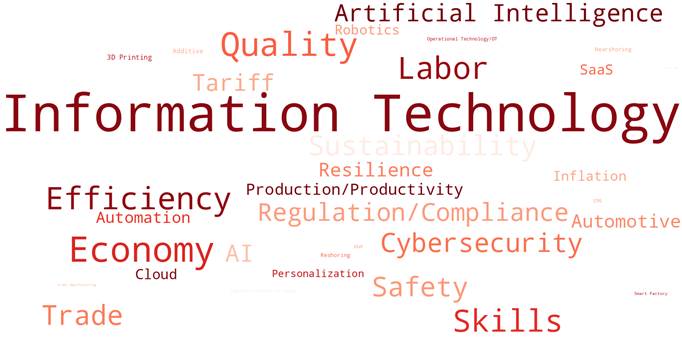
Economic Pressures and Trade Shifts
The economy reigned supreme as the leading term driving manufacturing coverage by business press and trade media alike. With shifting interest rates, supply chain volatility, geopolitical tensions, trade and tariffs are once again making headlines. Business press publications covered these stories at a higher rate, as they tied these forces to broader market impacts, covering how tariffs on specific countries or materials have rippling effects on various industries.
Key Takeaway:
When speaking to media, communications professionals in manufacturing sectors should connect company updates to macroeconomic implications. Data matters, so companies should aim to quantify how trade shifts or reshoring strategies impact costs, jobs or market competitiveness.
Labor Trends and Workforce Impacts
Labor and workforce issues also ranked highly among the most covered topics. Reporters covered economic impacts of the skilled worker shortage in the manufacturing industry, as well as the ramifications of these shortages for the administration’s desire to ramp up U.S.-based manufacturing.
These realities provide a human-interest component to these trends, as readers want to understand how workforce challenges affect real people. Readers want to see behind the curtain of how employees are adapting to automation, how communities reliant on manufacturing jobs are trying to stay ahead or how the next generation of employees are learning how to thrive in a digital-first manufacturing future.
Key Takeaway:
Don’t just speak to the obvious labor shortage but look for ways to add value and elevate the facts with anecdotes. Highlight workforce investments, employee stories or measurable outcomes from training initiatives to give journalists the human story their readers crave.
Robotics, Automation and AI
Automation is not new in manufacturing, but recent advances in AI are accelerating transformation across the factory floor. From predictive maintenance to AI-driven computer vision for quality control, these technologies help manufacturers improve efficiency, optimize production, and enhance safety while minimizing downtime.
Collaborative and autonomous robotics are also increasingly being integrated into repetitive or high-risk tasks, augmenting human workers and allowing them to get more done. However, the flip side of this trend is the concern for replacing human workers.
Key Takeaway:
Focus on measurable improvements when discussing AI and automation with reporters, such as productivity gains, safety enhancements and workforce augmentation. Innovation is important in this trend. Leverage case studies to avoid generic hype and focus on real-world uses. Journalists respond to concrete examples and stories where technology delivers tangible business or human benefits.
Quality and Efficiency
From the production saga in the airline industry to the listeria outbreaks in the food industry, maintaining high levels of quality and efficiency remains central to manufacturing success. Not only are these topics relevant to readers and the public who may be impacted by missing the mark, but they are also top of mind for company leaders. As skills/talent trends persist and manufacturers are learning to do more with less, readers want to know how they’re prioritizing efficiency, and what impact that will have on quality itself.
In the instance of a major national recall, journalists want to get to the bottom of what happened to cause it, who might be impacted and how and – even more important – the company’s reaction and steps it’ll take to resolve the issue. You can learn about our crisis communications services to learn more.
Key Takeaway:
Beyond product enhancements that help manufacturers achieve quality and efficiency, highlight real-world, innovative investments in these areas, such as smart factories, that create growth and change the industry. Sharing concrete examples of where companies minimized defects, reduced waste, and improved efficiency without sacrificing quality help illustrate the message. Showing measurable impacts also helps make the story more newsworthy and relatable.
Turning Manufacturing Challenges into Media Opportunities
The manufacturing landscape is changing fast, and newsrooms are under similar pressures to evolve and adapt amidst worker shortages. This means communicators need to cut through the noise and highlight the human impacts, create a relatable narrative and build relationships that ensure we’re delivering what media want to see.
Read more about our media relations services here: https://10fold.com/services/media-relations/