Key Article Takeaways
- Effective MedTech storytelling bridges the gap between scientific complexity and human understanding.
- Narrative frameworks rooted in empathy and clarity drive stakeholder engagement.
- Visual storytelling, data simplification, and patient-centric narratives reshape how innovators communicate.
- Strategic storytelling accelerates adoption, builds trust, and supports investment momentum.
In an era of unprecedented scientific advancement, MedTech companies face a unique communications challenge: how to translate complex science into narratives that resonate clinicians, investors, patients, and policymakers.
At its core, MedTech storytelling isn’t about simplifying jargon; it’s about crafting narratives that illuminate meaning, evoke emotion and build credibility.
This guide explores why narrative matters in MedTech, how it has evolved, and the strategies innovators should adopt in 2026 and beyond to ensure their stories stand out in a crowded information environment.
Why MedTech Storytelling Matters
MedTech innovation drives progress, from advanced diagnostics and cutting-edge therapeutics to AI-assisted imaging and robotics. However, even transformative technology struggles to gain traction if stakeholders can’t grasp its value.
Reporting from STAT Health Tech by Mario Aguilar highlights how AI-guided cancer treatments and diagnostic tools are evolving in clinical settings. Coverage like this demonstrates that clinicians need narratives that translate technical advancements into practical application.
Traditional scientific communication prioritizes precision. Peer-reviewed publications, regulatory filings, and clinical abstracts remain essential. Yet these formats often lack narrative structure. A compelling story humanizes data, connects outcomes to real-world impact, and situates innovation within a broader mission.
For search visibility and audience engagement, MedTech storytelling also supports:
- Clearer keyword alignment
- Higher dwell time
- Improved content comprehension
- Stronger thought leadership positioning
The Evolution of MedTech Communications
Historically, MedTech communications relied heavily on data-dense slide decks and technical timelines. This approach assumed audiences possessed deep domain expertise.
The landscape has shifted. Major health and business outlets increasingly frame MedTech innovation through:
- Patient impact
- Workflow transformation
- Health system efficiency
- Market implications
Here’s a look at the top keywords that appear most in MedTech-focused articles:
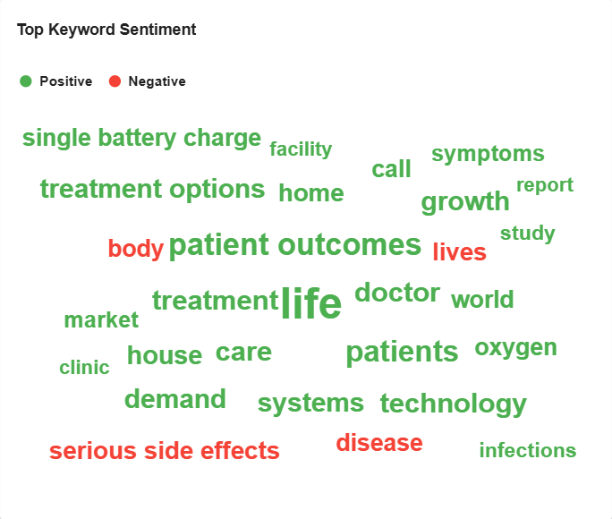
Source: Meltwater
For example, a recent article in BioWorld explores how AI adoption responds to real clinical demand, emphasizing funding trends and operational integration rather than isolated performance metrics.
Similarly, reporting from CES highlights user-facing benefits of robotics and intelligent systems. Journalists now emphasize practical impact over technical specification.
This evolution reflects a broader content shift toward narrative frameworks that prioritize clarity, accessibility, and stakeholder relevance.
Core Principles of Effective MedTech Storytelling
Breakthrough science alone does not guarantee understanding. Understanding is what drives adoption, trust, and investment. The most effective MedTech storytelling follows structured principles that transform complexity into clarity without sacrificing rigor.
1. Start with the Human Element
Every medical innovation addresses a human problem.
Leading with patient experience, clinician challenges, or systemic inefficiencies establishes relevance. Instead of opening with technical specifications, begin with the unmet need that sparked the innovation.
During the COVID-19 pandemic, Stirling Ultracold reframed the role of ultra-low temperature freezers as critical vaccine infrastructure. The campaign connected technical capability directly to global public health urgency.
Human context improves comprehension and emotional engagement while maintaining scientific integrity.
2. Simplify Without Sacrificing Accuracy
Translating technical content for broader audiences doesn’t mean oversimplification. It means distilling complex concepts into clear, accurate, and audience-appropriate language.
Effective strategies include:
- Using precise metaphors to explain mechanisms
- Breaking processes into step-based sequences
- Connecting new concepts to familiar frameworks
This approach improves accessibility while preserving credibility.
3. Use Visual Storytelling Strategically
Visual elements accelerate comprehension by clarifying relationships and processes.
IQVIA demonstrates data-driven insights through compelling visual storytelling, incorporating graphs and flow diagrams that simplify complex data sets. For example, IQVIA’s Digital Health Trends 2025 report combines narrative insights with data visualizations that help stakeholders quickly grasp shifts in technology adoption and healthcare investment trends. These visuals transform intricate analytics into intuitive formats that make the data accessible and engaging.
In MedTech communications, effective visual assets include:
- Workflow infographics
- Comparative charts
- Annotated device illustrations
- Mechanism animations
These tools are not add-ons; they are essential storytelling elements that make science accessible.
4. Integrate Data Into the Narrative Flow
Data strengthens credibility when integrated into structured narrative.
Instead of presenting metrics in isolation:
- Introduce a question or problem first.
- Present data as evidence that moves the narrative forward.
- Explain what the numbers mean in context.
Abbott applies this approach in messaging for FreeStyle Libre, connecting glucose performance metrics to improved daily management and fewer fingersticks.
This narrative flow helps stakeholders connect dots rather than just read bullets.
5. Tailor Stories to Your Audience
The way you tell a story for a clinical conference is different from how you tell it to investors or patients.
Effective communicators segment their narratives based on audience needs:
- Clinicians prioritize mechanistic clarity and clinical evidence.
- Investors focus on market potential and risk/benefit insights.
- Patients value compassion, relevance, and clear outcomes.
Stryker illustrates this approach by presenting surgical precision benefits for clinicians, operational reliability for hospital systems, and growth potential for investors.
Crafting variations of your core story ensures resonance across stakeholder groups.
Looking Ahead: The Narrative Imperative in 2026 and Beyond
As the MedTech ecosystem grows more complex, the need for clear, emotionally intelligent storytelling will only intensify. Scientific breakthroughs will continue to accelerate, but understanding will not automatically follow.
Innovators who master narrative translation gain measurable advantages in:
- Market adoption
- Investment confidence
- Real-world impact.
In 2026 and beyond, MedTech storytelling must blend clarity with credibility, data with meaning, and science with human context.
In a market saturated with breakthroughs, competitive differentiation will depend not on scientific complexity alone but on the ability to translate complexity into conviction.