Key Takeaways:
- Robotics and physical AI coverage is shifting from futuristic curiosity to deployment, productivity, and business value.
- Efficiency and productivity dominate coverage, but ROI storytelling remains underdeveloped and wide open.
- Humanoids attract attention, but collaborative robots (cobots), autonomous mobile robots (AMRs), and industrial automation are driving the deeper media conversation.
- Connecting technical innovation to real-world outcomes is key to standing out in a crowded market.
After years of AI living mostly in screens, chats, copilots and workflows, the next wave of the conversation is starting to look a lot more physical.
Robotics and physical AI have taken off, with the global robotics market projected to nearly quadruple this decade, from about $100 billion in 2025 to almost $392 billion by 2033. Momentum is spreading across factories, warehouses, hospitals, farms and defense environments.
For communications and marketing professionals, this momentum creates both an opportunity and a challenge. The category is exciting, but it is also crowded, technically complex and increasingly tied to major business issues, including labor gaps, workplace safety, supply chain pressure, productivity and global competitiveness. Reporters are still interested in innovation, but novelty alone is rarely enough. They want to understand where robots are being deployed, what problems they solve, how they affect workers, and how they fit into larger economic and geopolitical trends.
A Closer Look at the Robotics Media Conversation
In this media analysis, we analyzed U.S. and Canadian media coverage from April 2025 through April 2026 to understand how robotics and physical AI are showing up in the news.
We looked at a broad base of robotics and physical AI coverage, then analyzed the terms and messages appearing most often across those conversations. This kind of analysis helps communications and marketing teams identify which topics and storylines are earning media attention, which angles may be oversaturated, and where companies may have an opportunity to introduce sharper, more differentiated narratives.
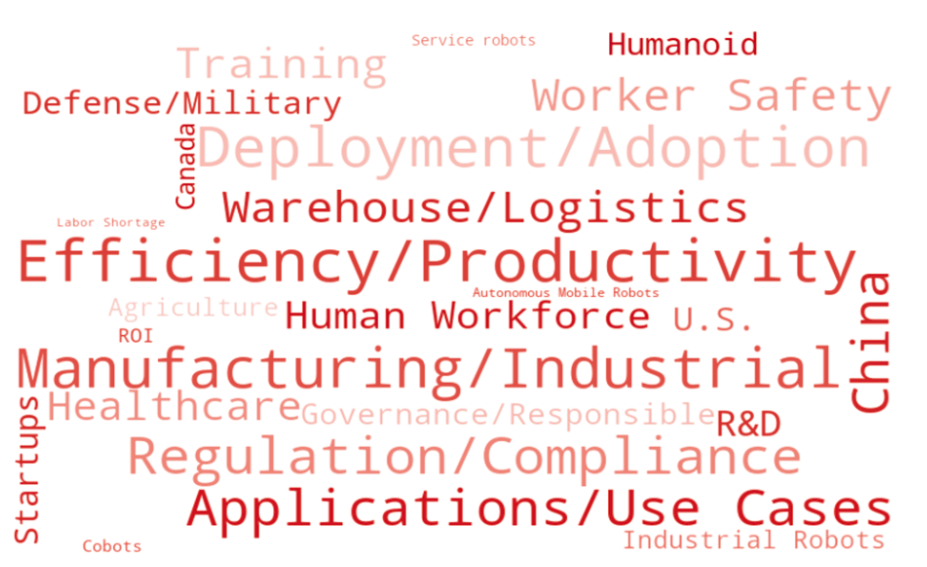
The data makes one thing clear: robotics coverage is not being driven by sci-fi curiosity alone. Media interest is clustering around practical performance, deployment, industrial use cases, regulation, safety and global competition.
Key takeaway:
Reporters want to understand where these technologies are actually deployed and what business impact they deliver. Robotics companies often have highly technical stories to tell, but the media landscape appears to be rewarding proof of operational relevance. For communications professionals in this sector, this means a new capability matters most when it is tied to something concrete, such as faster fulfillment, reduced downtime, safer inspection, improved consistency or higher throughput.
Productivity and Deployment Dominate Robotics Coverage
Productivity appeared in 149,810 articles, making it one of the strongest themes in the dataset. Deployment/Adoption appeared in 143,980 articles, while applications/use cases appeared in 119,140 articles. These trends show that media conversations increasingly focus on how robotics systems improve operations across industries.
In manufacturing, productivity may show up as faster production cycles or fewer bottlenecks. In logistics, it may mean improved picking, sorting, routing or inventory movement. In healthcare, it may involve reducing repetitive tasks or optimizing hospital logistics.
With the high volume around efficiency, productivity, and adoption, it was interesting to see that ROI appeared in only 15,330 articles, a much smaller share of the broader conversation. Media coverage is clearly interested in what robotics can improve and where these systems are being deployed, but the hard economics of robotics appear less developed as a standalone theme.
This gap may reflect the complexity of measuring ROI across different environments, or it may suggest that many companies are still speaking in broad efficiency terms rather than offering detailed proof. Either way, the gap creates room for stronger business storytelling.
Key takeaway:
The word “productivity” can be broad, so the strongest stories will make it specific. What process became faster? What task became safer? What cost was reduced? What output improved? What changed for the human team?
For marketing and communications teams, the opportunity is to move beyond general claims and build narratives around measurable outcomes. Reduced downtime, lower operating costs, faster throughput, fewer safety incidents, improved accuracy and better asset utilization all make the productivity story more credible. As the category matures, ROI proof points may become one of the clearest ways to separate serious deployments from speculative narratives.
Humanoids Turn Heads, But They’re Not the Whole Story
Humanoid robots are one of the easiest robotics stories to visualize, and they are certainly getting media attention. The term appeared in 43,680 articles during the period analyzed. That is meaningful volume, but surprisingly, it does not dominate the broader conversation.
Humanoids trailed U.S., efficiency/productivity, deployment/adoption, manufacturing/industrial, regulation/compliance, applications/use cases, China, worker safety, warehouse/logistics, training, healthcare and human workforce coverage. In other words, humanoids may be a strong media hook, but they are not the whole robotics story.
Other robot categories received lower but still notable attention:
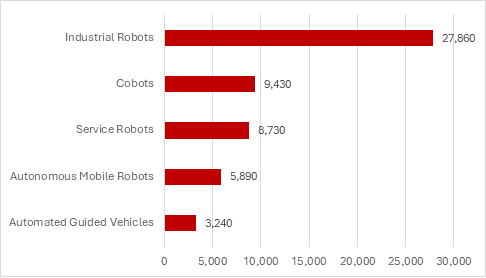
This spread suggests that while humanoids may attract curiosity, the broader conversation is also being shaped by systems that are closer to commercial use, particularly in industrial and operational settings.
Key takeaway:
Specificity matters. A humanoid story, a cobot story, an AMR story and an industrial automation story will not land the same way. Each one raises different questions about cost, deployment timelines, safety, labor impact and technical differentiation.
For communications and marketing teams, the lesson is to avoid treating “robots” as a single media category. A humanoid pitch may benefit from a strong visual angle and a future-of-work narrative, while an AMR story may need to focus on warehouse throughput, integration and operational ROI. A cobot story may be strongest when it emphasizes worker augmentation and safety. Matching the message to the appropriate category, buyer concern and media beat will make outreach more relevant and less generic.
With Great Automation Comes Great Responsibility
The media conversation around robotics is increasingly tied to topics of safety, regulation, workforce impact and responsible deployment.
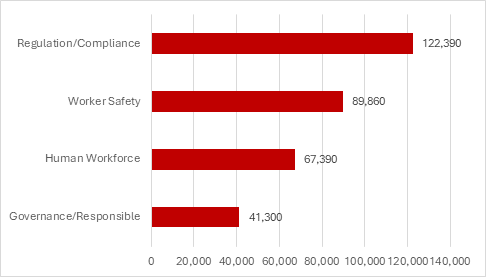
This volume points to a broader media focus on control, accountability and trust as robotics and physical AI move into real-world settings.
Physical AI introduces questions that are different from software-based AI. Robots operate near people, equipment and infrastructure. They make decisions in dynamic environments. They may be used in workplaces where safety, liability and compliance already carry serious consequences.
Key takeaway:
Safety and governance are likely to remain core parts of the media conversation. Companies should be prepared to explain how systems are tested, what safeguards are in place, how workers are trained and what accountability looks like when autonomous systems are deployed.
The U.S.-China Dynamic Is Hard to Ignore
The term U.S. appeared in 177,500 articles, while China appeared in 106,820 articles. U.S. and China together appeared in 50,290 articles.
This points to a larger narrative around national competitiveness. Robotics and physical AI are being discussed in connection with manufacturing strength, industrial strategy, supply chains and technological leadership.
Key takeaway:
The robotics story is bigger than individual products. Media may be looking for perspectives on where innovation is happening, how countries are investing, what supply chains depend on and which regions are positioned to lead.
How Robotics Companies Can Tune Their Message
The robotics and physical AI conversation is moving quickly, but the coverage is not only chasing novelty. The strongest themes point to a more grounded media environment.
Reporters are interested in whether robots can improve productivity, where they are being deployed, which industries are adopting them, how safe they are, how they affect workers and what role they play in the global technology race.
Communications and marketing teams need to translate technical capabilities into clear narratives that show why the technology matters, who it helps, and what problem it solves. Strong messaging is the foundation of that work — it ensures that every pitch, campaign, and executive conversation starts from a consistent, compelling core before it reaches any audience.
Here are three tips to make sure your story resonates:
- Lead with the business or human problem, then explain the technology. Highly technical messaging can lose readers quickly. Start with the operational challenge, then show how the robotics system addresses it.
- Quantify impact and use real-world examples whenever possible. Real-world outcomes help move the message from concept to credibility. Case studies, pilots, customer data and implementation details give reporters stronger material to work with and make it easier to show how the technology performs outside of a demo environment.
- Tailor the message by audience. A business reporter, trade journalist, and investor audience will not care about the same details. Adapt messaging by outlet type, industry vertical and stakeholder priority.
Robotics companies have no shortage of technical innovation to talk about. The communications challenge is translating that innovation into a story that is timely, credible and useful to the audiences shaping the conversation. The companies that do this well will be better positioned to earn coverage, build trust and stand out as physical AI moves from experimental promise to operational reality.